
Running a Sex Offender Check in Concho County
The Texas Public Sex Offender Registry is the main public search for Concho County. Texas DPS manages the system under Code of Criminal Procedure Chapter 62, while local law enforcement authorities collect and verify registration information within their jurisdictions. The registry is free and offers several ways to search, so a person does not need a known name to check an area.
Use a county search for a broad Concho County list. A city or ZIP search can focus on Eden or Paint Rock, while an address or map route is more useful near a home, school, route, or family destination. A name search works best with a complete surname and given name. The state identifier, or SID, is the most exact route when it is already known. Because local authorities supply the data, send a suspected error to law enforcement or the DPS registry unit.
Searching the Texas Public Sex Offender Registry
DPS supports popular, name, address, institute of higher education, map, and SID searches. The public endpoint timed out during automated research, so exact radius choices must be read from the live interface. Do not rely on a radius value quoted by an unofficial site. The DPS registration program explains the statewide system and notification roles.
- Open the official Texas registry and choose the search type that fits the question.
- For broad local coverage, select Concho County. For a tighter check, enter Eden, Paint Rock, a ZIP code, or an address and live radius choice.
- Review each result for name, photograph, physical details, and location. Do not match on one field alone.
- Open the full profile and read the reportable offense, registration status, verification data, and public notices before drawing a conclusion.
| Field Label | Type | Required | Notes |
|---|---|---|---|
| Search type | Tabs or options | Yes | Name, address, higher education, map, or SID |
| Last Name | Text | Name route | Enter surname |
| First/Middle Name | Text | No | Narrows a name match |
| City/County/ZIP | Text or selector | Area route | Use Eden, Paint Rock, Concho, 76837, or 76866 |
| Address/Radius | Text and selector | Address route | Read current radius choices in the live registry |
| SID | Text | SID route | Exact state identifier |
The interface also provides submit or search and clear controls. A county result offers breadth, while the name, SID, and address routes answer more exact Concho County registry questions.
Concho Registry Area Searches
A city-only search can be too narrow in a rural county. Paint Rock and Eden are the only incorporated cities, but a location may use a city mailing name while sitting beyond municipal limits. Start with Concho County to see the wider public list. Then run an address or map search around the place that matters. Near Eden's limits, compare both methods because registration authority follows jurisdiction rather than the wording of a postal address.
The official registry search source shows the public Texas interface assigned to Concho County checks.
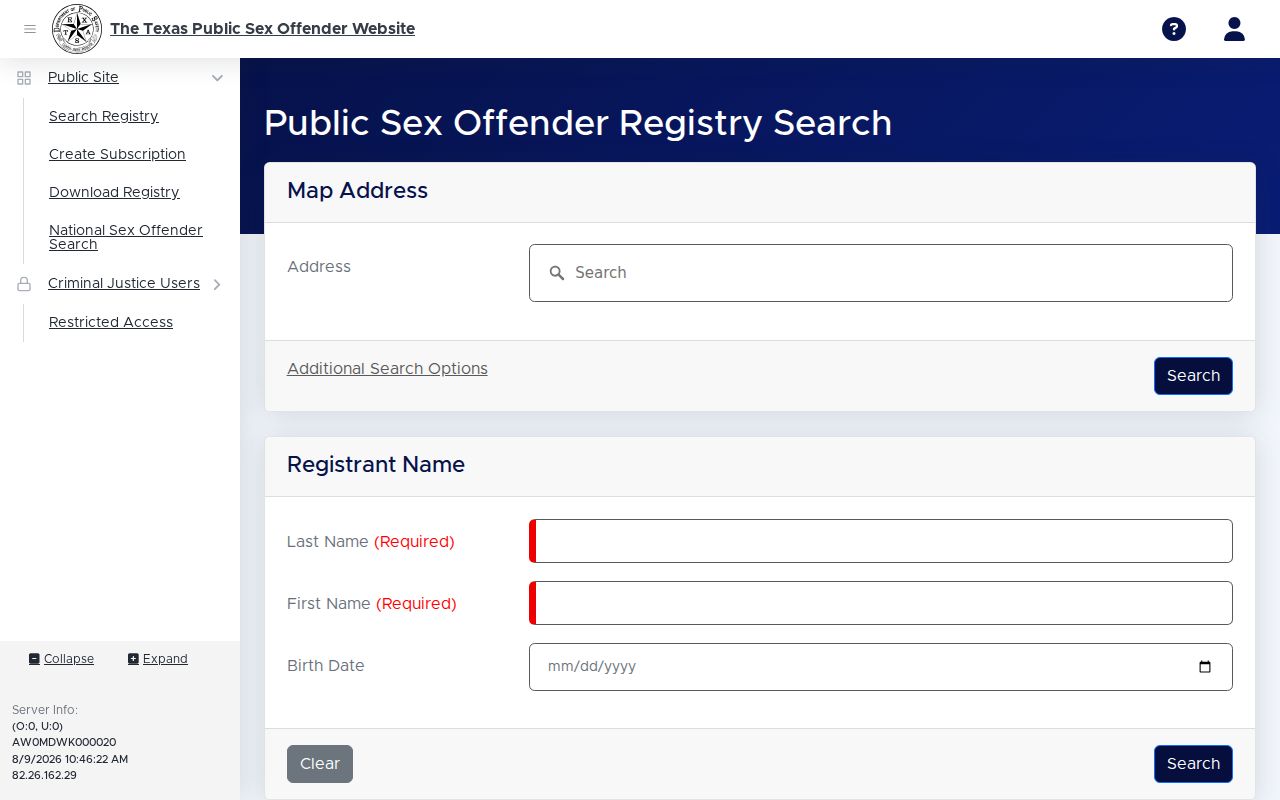
The interface supports both person-based and place-based searches, which helps account for Concho County's wide rural area.
Use the current-profile map as a lead, not a guarantee that a person will be at a location at a given time. DPS warns that information can change and depends on data submitted by local authorities. If the map and street details conflict, call the authority that holds the registration. Do not visit the listed address to investigate.
What a Registry Profile Shows
A public Concho County registry profile is built to identify the listed person, describe the registered location, and explain the reportable offense and duty. It may include facts from more than one jurisdiction. Read the offense date and court jurisdiction instead of assuming that every listed offense occurred in Concho County.
| Name & Aliases | Current name, known aliases, registration number, and SID when public. |
|---|---|
| Photo & Description | Photograph, sex, race, age or birth data, height, weight, hair, eyes, and marks. |
| Registered Location | Published address or location description and map. |
| Offense Record | Reportable offense, statute, adjudication date, court, jurisdiction, and public victim-age category. |
| Risk Information | Assigned Texas risk level and high-risk or civil-commitment notice when applicable. |
| Status & Verification | Registration status and available verification information. |
| Other Public Fields | Scars, tattoos, vehicle details, or school information when collected and publishable. |
The public profile does not publish Social Security numbers, driver's-license numbers, phone numbers, online identifiers, victim-identifying data, or employer contact details. Some juvenile information can also be ordered nonpublic. Those gaps are privacy rules, not signs that the profile is incomplete.
Concho Registry Profiles Show and Hide
Registry information describes a legal registration duty. It does not prove present dangerousness, announce that a new crime occurred, or replace a current police report. A photograph and physical description help distinguish people with similar names. Offense and court fields explain why the duty exists. Verification and status fields help a reader decide whether local follow-up may be needed.
The Texas DPS registry overview is the official source for how public access and local reporting fit together.
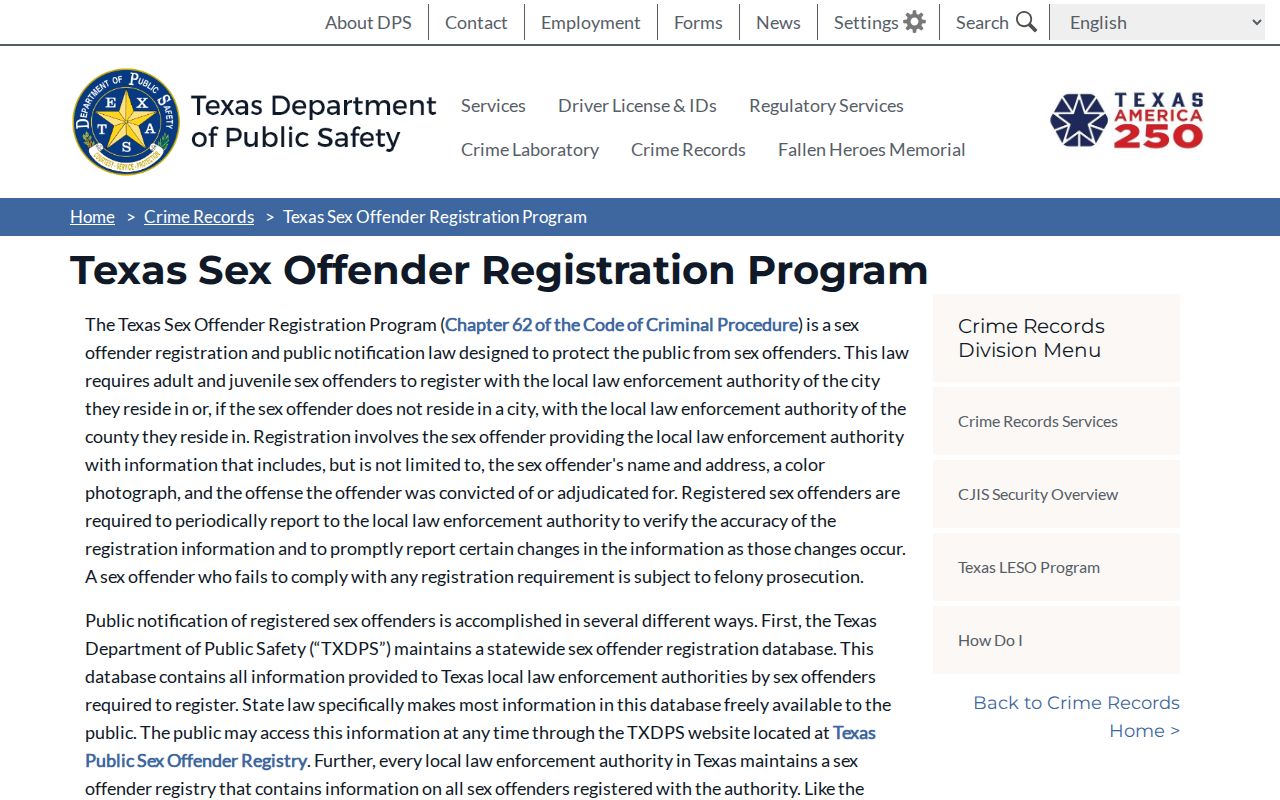
The overview helps explain why Concho County law enforcement verifies local data while DPS runs the public statewide database.
Do not infer unlisted facts. An omitted phone number or workplace is intentionally outside the public profile. A map point should be checked against the written location. When two profiles share a name, compare the photo, age, physical details, aliases, and registration identifier before concluding they concern the same person.
Registration Requirements and Levels in Texas
Texas does not use the federal Tier I, II, and III labels as its ordinary public duration table. Adult registration is generally either ten years after discharge from incarceration, parole, or community supervision, or life, depending on the reportable offense and circumstances. Juvenile registration generally runs to the tenth anniversary after the relevant release, discharge, or dismissal, subject to court orders and statutory exceptions.
| Texas Category | General Duration | Public Significance |
|---|---|---|
| Adult ten-year duty | 10 years after discharge from supervision | Public information generally remains available while the duty exists |
| Adult lifetime duty | Life | Ongoing verification; notice may increase with risk findings |
| Juvenile adjudication | Generally 10 years after relevant discharge | A qualifying court order may make information nonpublic |
| Civilly committed or high-risk release | Life or governing duty | Postcard notice may apply when statute conditions are met |
Code of Criminal Procedure Article 62.101 controls duration. Articles 62.051 and following govern registration and change reporting. A registrant generally must report by the seventh day after arrival or on the first date the authority's policy permits, whichever is later, and must report specified changes as required. The exact duty turns on the offense and order, not a simple label shown by an unofficial list.
Concho Registry Searches Across States
The Texas registry covers reporting supplied within Texas. If a personal or family safety search involves travel, a prior address, or a location near another state, use the National Sex Offender Public Website as a second layer. The U.S. Department of Justice service searches participating state, territorial, and tribal public registries. It is a supplement, not a replacement for the Texas profile and local authority.
The official NSOPW source provides the national search assigned to Concho County registry research.
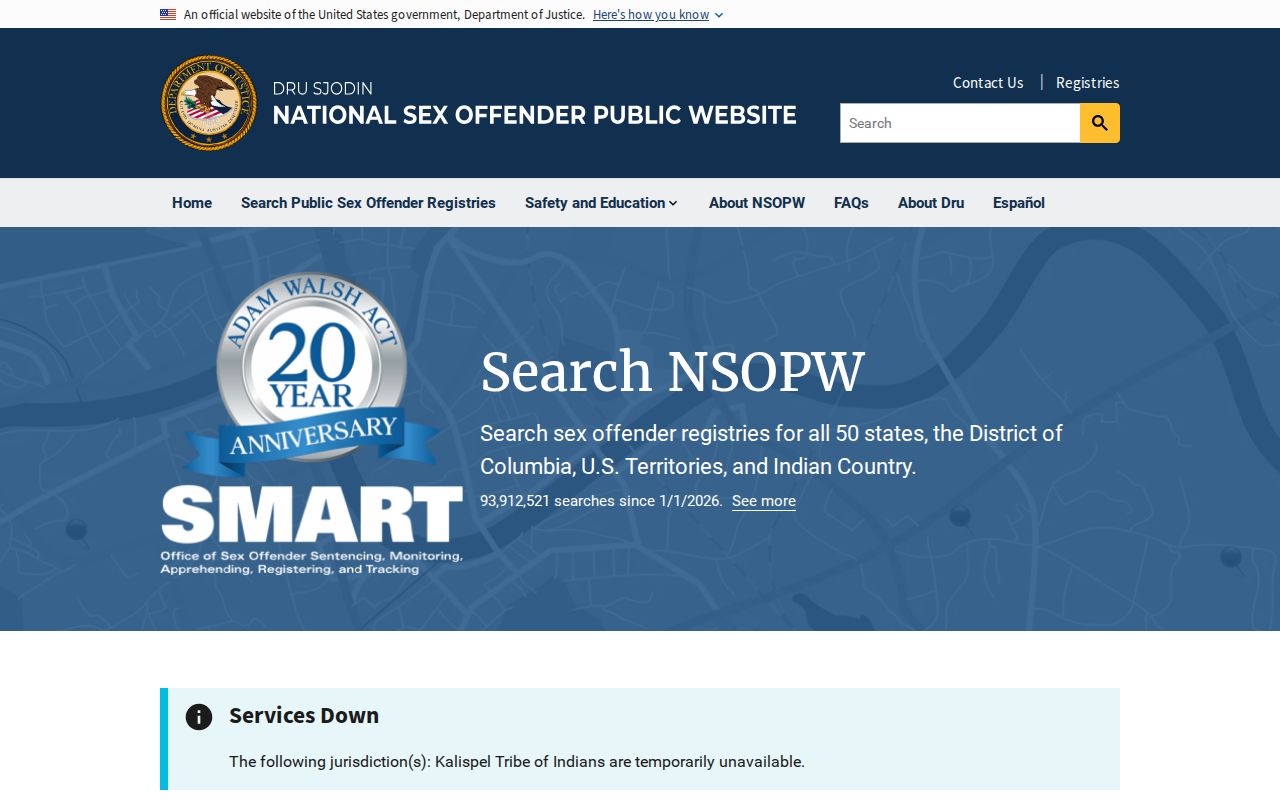
The national layer is useful when a name or address history extends beyond Concho County or Texas.
Search results still come from participating jurisdictions, so open the linked source profile and read its status. If Texas and national results differ, use the Texas DPS entry and local Concho County authority to verify the current local registration. No verified Concho sheriff app, local email alert, or app-only offender map was found. Use DPS and NSOPW rather than an unofficial alert service.
Concho Registry Notice and Distance
Texas has no simple statewide rule that places every registrant the same number of feet from every school, park, or child-care site. Parole and community-supervision conditions may impose limits on a specific person. A municipality may also have an ordinance, but no official Concho County distance ordinance was located. Do not turn a registry map radius into a legal residence boundary.
Community notice can include the public DPS database, locally held registration data, lawful publication, school notices, and postcard notice for certain high-risk or civilly committed people. Articles 62.201 and following address risk assessment and community notification. A postcard is a targeted statutory measure, not an alert sent for every registry change.
For a current question about an Eden address, confirm jurisdiction through city or sheriff dispatch. For Paint Rock or an unincorporated Concho County location, start with the sheriff. The DPS Sex Offender Registration unit can be reached at 512-424-2800 for state program questions.
Lawful Use and Community Notification
Use Concho County registry information for awareness, safety planning, and informed talks with family members. Keep the response tied to official facts. If a profile seems out of date, record the public profile link and discrepancy, then contact the registration authority. If a possible registration violation is occurring, report it to law enforcement. Failure to comply with registration duties is a felony under Article 62.102, but the public should not investigate or confront the listed person.
Misuse is a crime: Do not use registry information to threaten, stalk, trespass, harass, or commit any offense. Texas Code of Criminal Procedure Chapter 62 authorizes public release and protects authorized governmental action, but it does not excuse criminal or civil misuse.
DPS states that local authorities provide registry data and that information can change. Verify the current address through the official portal and send discrepancies to the authority that maintains the registration. For suspected noncompliance, use the sheriff, Eden dispatch, or the DPS unit. Call emergency services only for an immediate threat.
Registry presence is not permission for vigilantism or discrimination. It also does not show that a person is at a listed address at the moment of a search. A measured response protects the community, preserves the integrity of any investigation, and reduces the risk of harm to uninvolved household members or neighbors.