
Criminal Cases in the Concho County Courts
Concho County criminal court cases are divided by jurisdiction. The 119th Judicial District Court hears felony indictments and the motions, pleas, trials, sentences, and revocation matters tied to them. The constitutional County Court handles ordinary Class A and Class B misdemeanor prosecutions. Fine-only Class C cases may instead belong to the Concho County Justice Court or Eden Municipal Court. That split explains why one search may miss a valid criminal case record.
The combined County and District Clerk is the custodian for the district and county court file. Amber Hall's office maintains filed pleadings, docket events, judgments, and copy services. The Justice Court keeps its own fine-only county matters, while Eden retains municipal ordinance and city Class C files. Start with the offense level and place of filing. If those are unknown, check the combined clerk first, then ask the lower courts whether they hold the case.
Concho County Court Levels
A case number alone is most useful when paired with the court. Concho County's small population does not merge every criminal docket into one database. Felony, misdemeanor, justice, and municipal files remain distinct even when the same event led to more than one record.
County and District Clerk
152 N. Roberts, Paint Rock, TX 76866
P.O. Box 98
325-732-4322
amber.hall@conchocounty.gov
Concho County Justice Court
152 N. Roberts, Paint Rock, TX 76866
P.O. Box 44
325-732-4706
Fine-only county cases
Eden Municipal Court
120 Paint Rock Street, Eden, TX 76837
325-869-2211
Municipal and city Class C cases
Use the official Texas district clerk directory to verify the clerk and the Eden court page for current municipal procedure. Court staff can locate records, but they cannot give legal advice.
How to Search Case Records
The Concho County clerk links directly to LGS Online Records Search and states that all records held in digital form are online. The local index updates at midnight, so a filing entered today may not appear until the next update. The live customer module did not expose every setting during research. Use only the controls shown for the Concho customer instead of assuming a filter exists.
- Open LGS and select Concho County as the customer.
- Choose the available party or case search route. Enter the surname first, or use an exact case number when known.
- Add a first name or date range to narrow similar results. Avoid filters that are not shown in the live Concho interface.
- Open the matching criminal case record and read the docket entries in date order. Treat a filed charge as an accusation, not a conviction.
- Ask the combined clerk for the underlying document or a certified copy when proof of the court's action is required.
| Field Label | Type | Required | Notes |
|---|---|---|---|
| County/customer | Selector | Yes | Select Concho County |
| Search category | Tab or dropdown | Yes | Party/name or case route as offered |
| Last/Company Name | Text | Usually | Start with the surname |
| First Name | Text | No | Narrows common names |
| Case/Instrument Number | Text | Alternative | Best exact lookup path |
| Date range | Dates | No | Narrows filing dates |
Search and reset buttons complete the documented control set. Results reflect the prior nightly update, so repeat a recent Concho County case search after midnight before moving to the clerk contact route.
Concho Dockets Update at Midnight
The clerk's nightly cycle is a key timing fact. A blank result does not prove that prosecutors declined a charge or that no Concho County criminal court case exists. The clerk may not have opened the case yet, the name may differ from the spelling used at booking, or the latest filing may be waiting for the midnight update.
The official LGS source shows the customer search route used for Concho County.
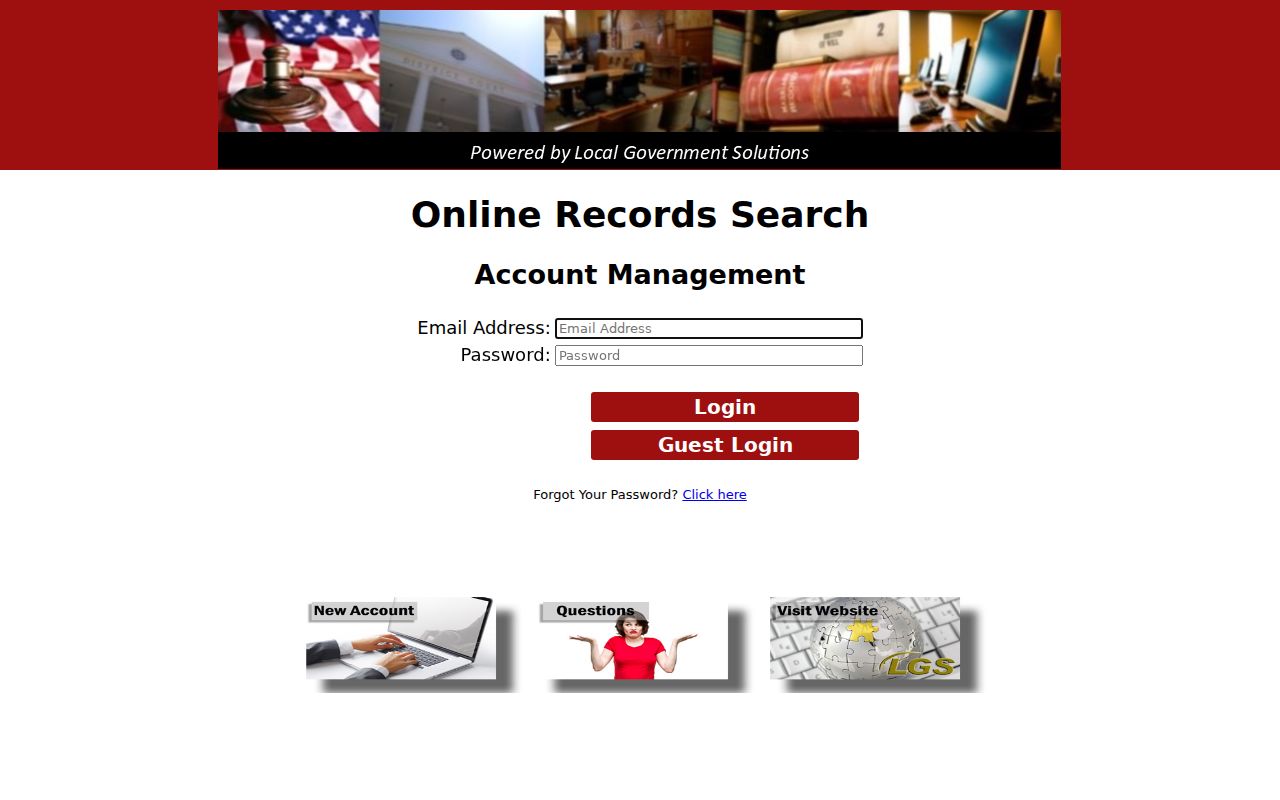
The search screen is a gateway to the clerk's digital index, not a substitute for a signed judgment or a call about a new filing.
If the result is still absent after the next update, email or call Amber Hall with the full name, approximate filing date, offense, and any case or tracking number. Older paper files and document images not posted online also require clerk help. For statewide e-filed material, re:SearchTX can supplement LGS, but its account access and court coverage vary. It does not replace the local clerk's certified record.
Note: A livestream of a court session may show a proceeding, but it is not an official docket entry or case document.
What the Case File Shows
A Concho County criminal case file follows the prosecution rather than the arrest. The complaint, information, or indictment states the formal accusation. It may differ from the initial booking charge after prosecutor review. Docket entries then mark settings, appearances, motions, plea activity, trial events, and the final action. The judgment and sentence are the controlling outcome documents.
| Case Number & Court | Identifies the filing and the court with jurisdiction. |
|---|---|
| Charging Document | States the filed charge, statute, and accusation approved for court. |
| Docket Entries | Lists dated filings, settings, motions, and court actions. |
| Parties & Counsel | May show the defendant, State of Texas, and attorneys. |
| Disposition & Judgment | Records dismissal, plea, verdict, deferred adjudication, or other result. |
| Sentence & Conditions | May list confinement, fine, costs, or community supervision. |
Bond data, linked cases, appeal references, and document image links may also appear when entered and made public. A portal display is useful for research. For a certified result, order the judgment or clerk's certified case record.
Read Concho Dockets with Care
Procedure is not outcome. An arraignment shows that the accused received the charge and entered or was asked for a plea. A setting shows that the court placed an event on its calendar. Neither proves guilt. A motion to revoke or adjudicate reports alleged community-supervision noncompliance; it is not the final revocation ruling. A capias may accompany that motion and should be confirmed with the issuing court.
- Indictment
- A grand jury's formal felony accusation.
- Deferred adjudication
- A plea-based result in which the court defers a finding of guilt; it is public in the DPS product unless nondisclosed.
- Dismissed
- The court ended that charge. The dismissal does not by itself erase an earlier booking record.
- Capias
- A court order directing an arrest, often tied to a case event.
- Judgment
- The signed court record of the disposition and key findings.
Read events in date order and open the final signed document when available. If an entry is cryptic, ask the clerk for the document title or copy. Do not ask court staff to predict the legal effect of a disposition.
Stages of a Criminal Case
A criminal matter can create records before it reaches the clerk. The arresting agency and booking custodian hold the first records. A prosecutor then decides whether to accept, change, or reject charges. Once filed, the proper Concho County court creates its case record. Pretrial motions and hearings follow. The matter can end by dismissal, plea, trial, or another lawful disposition, followed by a judgment and any sentence.
Case flow: Charges Filed → Arraignment → Pretrial → Plea or Trial → Disposition → Sentencing
The clerk, prosecutor, and supervision or custody agencies report qualifying later events to the Texas Department of Public Safety under Code of Criminal Procedure Chapter 66. Reporting lag can leave an arrest cycle without its final disposition in the statewide criminal-history file. The local judgment is the best source for what the court actually ordered.
Concho Charges Pick the Court
Texas offense class directs a case toward the right Concho County counter. The Texas Penal Code punishment chapter supplies the official classification framework.
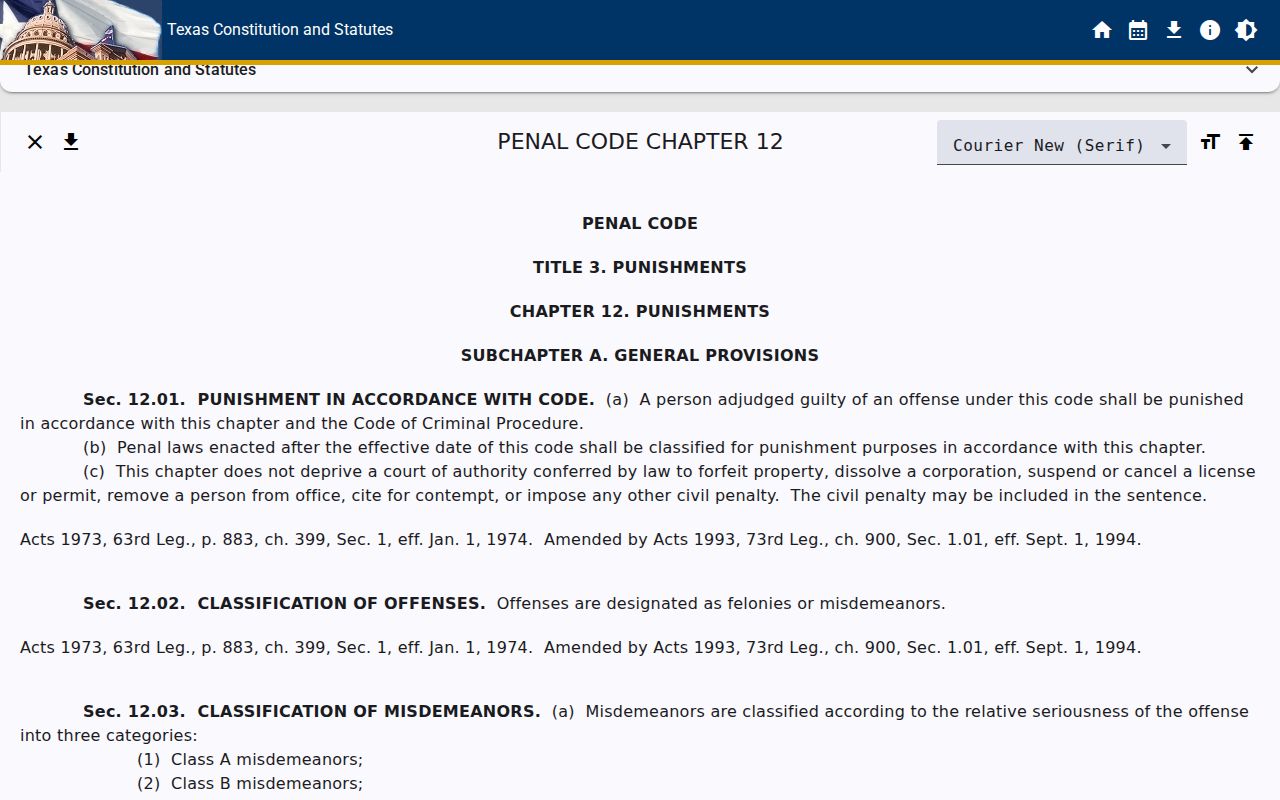
The classification source helps distinguish a district felony file from a county misdemeanor or lower-court citation.
Felonies belong in the 119th District Court. Class A and B misdemeanors ordinarily go to the County Court. A fine-only Class C matter may stay with the Justice Court or Eden Municipal Court and may never appear in the combined district and county criminal view. Eden's court says a case cannot be resolved by telephone; the person must appear or use U.S. mail. Its published procedure also requires juveniles age sixteen and younger, plus seventeen-year-olds with alcohol violations, to appear with a parent or guardian.
Appeals from Concho County go to the Third Court of Appeals. Federal prosecutions are different: they are filed in the Northern District of Texas and searched through PACER, not LGS. Keeping those layers separate prevents a false conclusion from the wrong portal.
Certified Concho Case Records
A screen print can help identify a Concho County criminal court case, but certification comes from the clerk. Contact Amber Hall when a signed judgment, sentence, indictment, or certified docket is needed. Provide the defendant's full name, case number if known, court, and the exact document requested. Ask for the current copy and certification cost because the research confirms statutory fees but does not publish a complete criminal-copy schedule.
Requests can be made at 152 N. Roberts in Paint Rock, by mail to P.O. Box 98, Paint Rock, TX 76866, by phone at 325-732-4322, or by email at amber.hall@conchocounty.gov. The clerk's official district clerk page is the source for current contact details and the LGS link.
Ask for the court's file, not a sheriff report, when the goal is to prove a filed disposition. If the goal is the arrest narrative or booking sheet, contact the arresting agency or sheriff instead. These records may share a name and date while documenting different stages.
Access & Restrictions
Public court access does not mean every document or data field appears online. Sealed and expunged matters should not be exposed. Juvenile law-enforcement files have added limits under Texas law, and victim details, Social Security numbers, motor-vehicle identifiers, and private data may be removed. An online docket can therefore be narrower than the paper or clerk-held file without being wrong.
Court records rest mainly on judicial rules, open-courts principles, and clerk duties. The executive-branch request steps in the Texas Public Information Act are not the main route for a court file. Send the request to Amber Hall rather than the sheriff. The sheriff is the right custodian for an agency report or booking document, subject to law-enforcement and privacy limits.
Verify the outcome: “Filed” describes an accusation placed before the court. Read the judgment or final disposition before describing the result.
When an expected Concho County record is absent, check spelling, the next midnight update, older paper holdings, and the correct court level. A restricted result should not be treated as proof that no case ever existed. The clerk can confirm whether a public file is held and what copy route is available without disclosing protected content.